
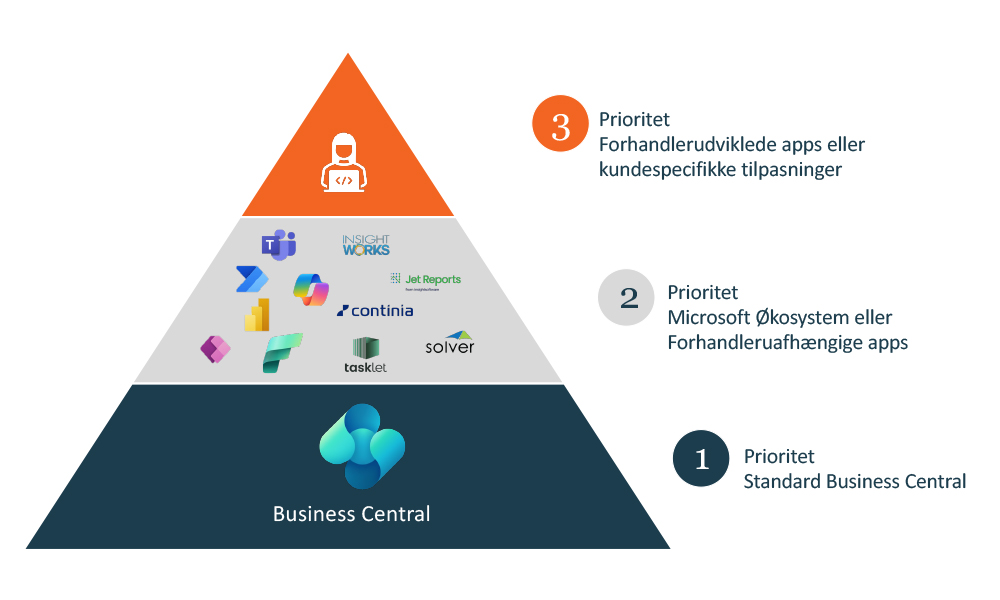
What do true vendor-independent apps and standard Business Central mean for your solution—today and in the future?
When companies invest in an ERP system, the focus is often on functionality, price, and implementation. But one of the most important questions often lies a little further in the future:
Given the solution, platform, and partner chosen, how free will the company be to develop, modify, and maintain the solution in three, five, or ten years?
This is where true vendor independence and standards come into play.
The ERP system must be able to outlast the partner
An ERP system is typically one of a company’s most important digital investments. Therefore, the solution should be built so that it can evolve alongside the company—regardless of who provides the consulting services.
Many companies naturally focus on who will implement the system. But it’s just as important to consider how dependent you’ll become on a partner, developer, or industry-specific app down the road.
Standards Create Freedom
Cloud solutions such as Microsoft Dynamics 365 Business Central are built on a standard platform that is continuously developed by Microsoft. When companies choose to build their ERP solution closely aligned with the standard, the solution becomes easier to maintain and upgrade, and new features can be implemented more quickly.
At the same time, the company is choosing a platform supported by one of the world’s largest software providers, which is continuously adapted to new technological capabilities, security requirements, and regulatory changes. This provides assurance that the solution will continue to support the business in the future.
A solution built on standards also makes it more robust and less vulnerable to changes. And last but not least, the company does not become dependent on a single vendor or developer. The result is greater freedom, greater flexibility, and an ERP foundation that can evolve in step with the company’s needs.
Apps should be chosen carefully—so you don’t end up “locked in”
Some companies have needs that go beyond the standard functionality of Business Central. That’s why apps play an important role in modern ERP solutions. Today, there are thousands of apps for Business Central that can expand functionality in areas ranging from production and inventory management to, for example, document management.
But precisely because there are so many options, it can be difficult to determine which apps are the right ones on which to build your solution. An app shouldn’t just address a current need. It must also be robust, maintained on an ongoing basis, and supported by a vendor that has the necessary resources to continue developing the product.
When companies select apps for their ERP solution, it is therefore important to consider factors such as the number of users, the vendor’s financial stability, the quality of support, and the track record for product development and updates. And, not least, how many partners work with the solution. And who can support it. This is often where an experienced Business Central partner can provide valuable advice and help assess which solutions are the most stable and future-proof.
When the solution is built on standard Business Central and vendor-independent apps, the company retains the freedom to continuously choose the components and partners that create the most value.
The most important thing: A foundation you can grow on
For many companies, ERP isn’t just about today’s needs. It’s about creating a foundation that can support growth, new workflows, and evolving requirements for many years to come. That’s why it’s important to consider how easily the solution can be adapted as the business evolves. Will it be continuously expanded with new functionality? Can new apps be implemented as needs change? And is the company free to choose a different consultant or partner if it wishes to do so?
The fewer constraints built into the solution, the greater the company’s freedom of action. An ERP solution built on standard Business Central and vendor-independent apps allows the solution to be continuously developed in step with the business, without being locked into specific vendors. This creates flexibility in day-to-day operations while also providing a stronger foundation for future decisions.
Build on standards and a strong ecosystem so you’ll have more options in the future.
We reserve the right to make corrections for any errors, omissions, or typographical mistakes.


