E-Documents in Business Central and the EU’s ViDA—what does this mean for your business?
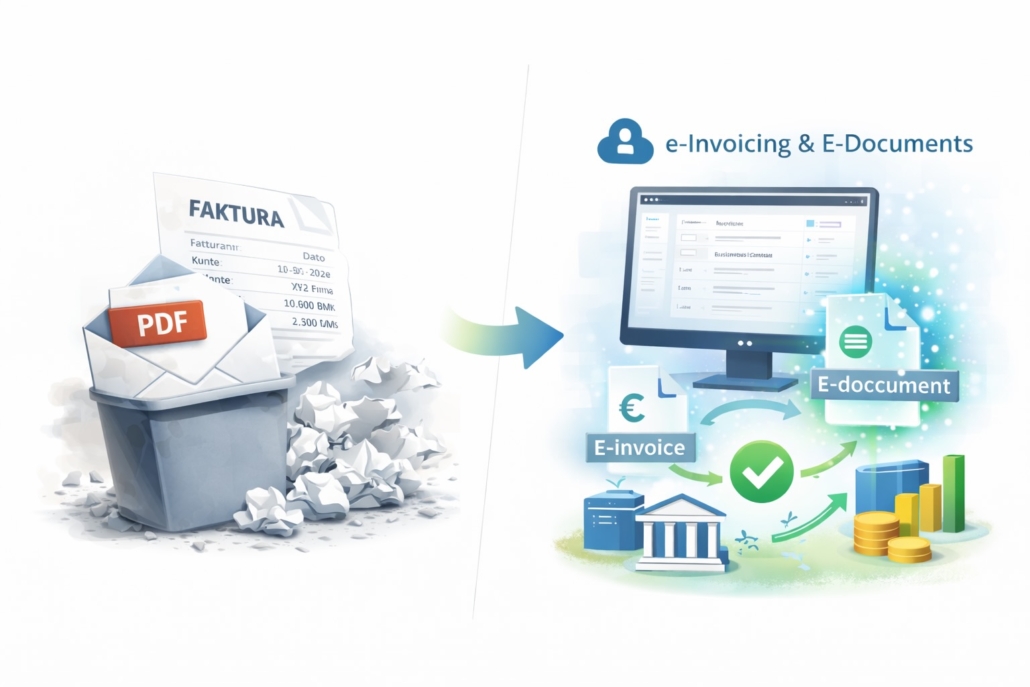
Starting in 2026, Denmark and the rest of the EU will gradually begin requiring that invoices between businesses be exchanged electronically— rather than, as many businesses do today, as PDFs via email.
This is part of the EU initiative ViDA—VAT in the Digital Age—which aims to create greater transparency, reduce errors, and simplify VAT reporting across countries.
For your business, this means that e-invoicing and digital document exchange are becoming even more important to understand and, if necessary, prepare your business for—regardless of whether you currently use Continia, other document solutions, or only use Business Central.
Why This Is Relevant to Your Business
1. The requirements are coming—regardless of size or industry
The EU is rolling out the requirements leading up to 2030.
Starting July 1, 2030, all B2B invoices within the EU must be structured e-invoices, not PDF files.
Denmark is expected to follow suit starting in 2026–2027.
This means that businesses must be able to send and receive e-invoices electronically—and share data digitally with government agencies.
2. Business Central will be ready on time—but you need to take action
Microsoft has already integrated e-invoicing into Business Central via the E-Document Framework.
This feature comes automatically with Business Central as a new standard feature that handles the exchange of e-invoices via networks such as PEPPOL.
For you, this means:
- You don’t need a new system—but your solution must be activated and set up correctly.
- If you use Continia’s products, you can use the Continia Delivery Network as the E-Documents highway at no extra cost. Alternatively, you can use another VANS provider.
In short: you don’t need to switch solutions, but you do need to adapt to the changing infrastructure.
What can Microsoft E-Documents do (that is, without Continia or other apps)?
You can use Microsoft E-Documents on its own or with an add-on app. It all depends on your needs.
With Microsoft E-Documents alone, you can:
- Send and receive e-invoices directly from Business Central—for example, via PEPPOL or national formats (OIOUBL, BIS3, Facturae).
- Exchange documents digitally with customers and suppliers—without PDFs or email.
- View the status of invoices ( sent, delivered, rejected).
- Comply with upcoming EU requirements for e-invoicing (ViDA 2026–2030).
E-Documents is Microsoft’s standard solution for legally compliant e-invoicing—simple, secure, and built into Business Central.
Normally, when you receive invoices as PDFs or images, you’ve needed OCR to extract the text and find amounts, dates, and line items.
E-Documents, on the other hand, are based on structured data (e.g., PEPPOL BIS 3). In this case, the invoice is sent in a data format that Business Central can read directly— without the need for OCR processing.
It’s not just about legal requirements—it’s about efficiency
Even without legal requirements, there are clear advantages to using E-Documents:
- Less manual work—invoices are approved and posted to the books faster.
- Better data quality—fewer errors in VAT, currency, and CVR numbers.
- Clearer overview—data can be used directly in Power BI and reporting.
- Better traceability – all documents are stored digitally with an audit trail for full transparency
- Scalability – The solution can handle increasing document volumes without requiring additional resources.
3 different scenarios—what does that mean for you?
Your situation |
What does this mean in practice? |
| You are currently using Continia | You’ll continue as usual, but your Continia solution will need to be connected to Continia’s E-Documents infrastructure (Continia Delivery Network). This will happen gradually in 2026–2027. You just need to make sure that your version of Business Central and your partner agreement support this. |
| You only use Business Central | You can use Microsoft’s E-Documents feature to send and receive e-invoices—without a separate app. It’s the fastest way to get ready for the new requirements. |
| You send a lot of PDF invoices | You should start planning for the transition now. PDFs will continue to work during a transition period, but they will not meet the requirements for e-invoices from 2026 to 2030. |
How to Prepare—Step by Step
Map out your document workflow
– Which invoices and documents are still sent manually?
Check your Business Central version
– Version 23 or later is required for E-Documents.
Is the technology in place?
– Confirm whether your environment is ready to send and receive e-invoices via PEPPOL.
Start on a small scale
– Test with selected customers and suppliers in 2026.
Get a GLN number at
A GLN number (Global Location Number) serves as your company’s electronic mailbox for e-documents.
This ensures that only valid e-invoices and approved formats can be received in Business Central—thereby helping you avoid unwanted files, spam, or incorrect documents.
A GLN number is issued by GS1 Denmark, which administers GLN numbers in Denmark.
You can order the number directly via www.gs1.dk.
Why is this important right now?
The legislation is on its way, and preparation takes time—especially if you have many customers and suppliers.
Microsoft’s E-Documents will become the standard—including for Continia and other document solutions.
The sooner you adapt your processes, the less disruption you’ll experience when the requirements become mandatory.
Next Steps
- Join our webinar on e-invoicing and E-Documents in Business Central.
- Schedule a brief overview with Vektus—we can help you see how E-Documents fit into your current setup.
- Plan how to automate your document workflow leading up to 2027.
- Use this transition as an opportunity to improve data quality, control, and reporting.
E-Documents aren’t just a technical innovation—they’re the next step in making finance and production more digital, transparent, and efficient.
Watch the webinar on demand
“Get Ready for E-Invoicing and the EU’s ViDA—with Business Central”
Watch our webinar, where we cover e-invoicing, ViDA, and the capabilities of E-Documents in Business Central.

