
It’s not just sensitive data you need to be careful with
Cybersecurity is a top priority at Vektus—both when it comes to our own systems and when we implement and work with solutions for our customers.
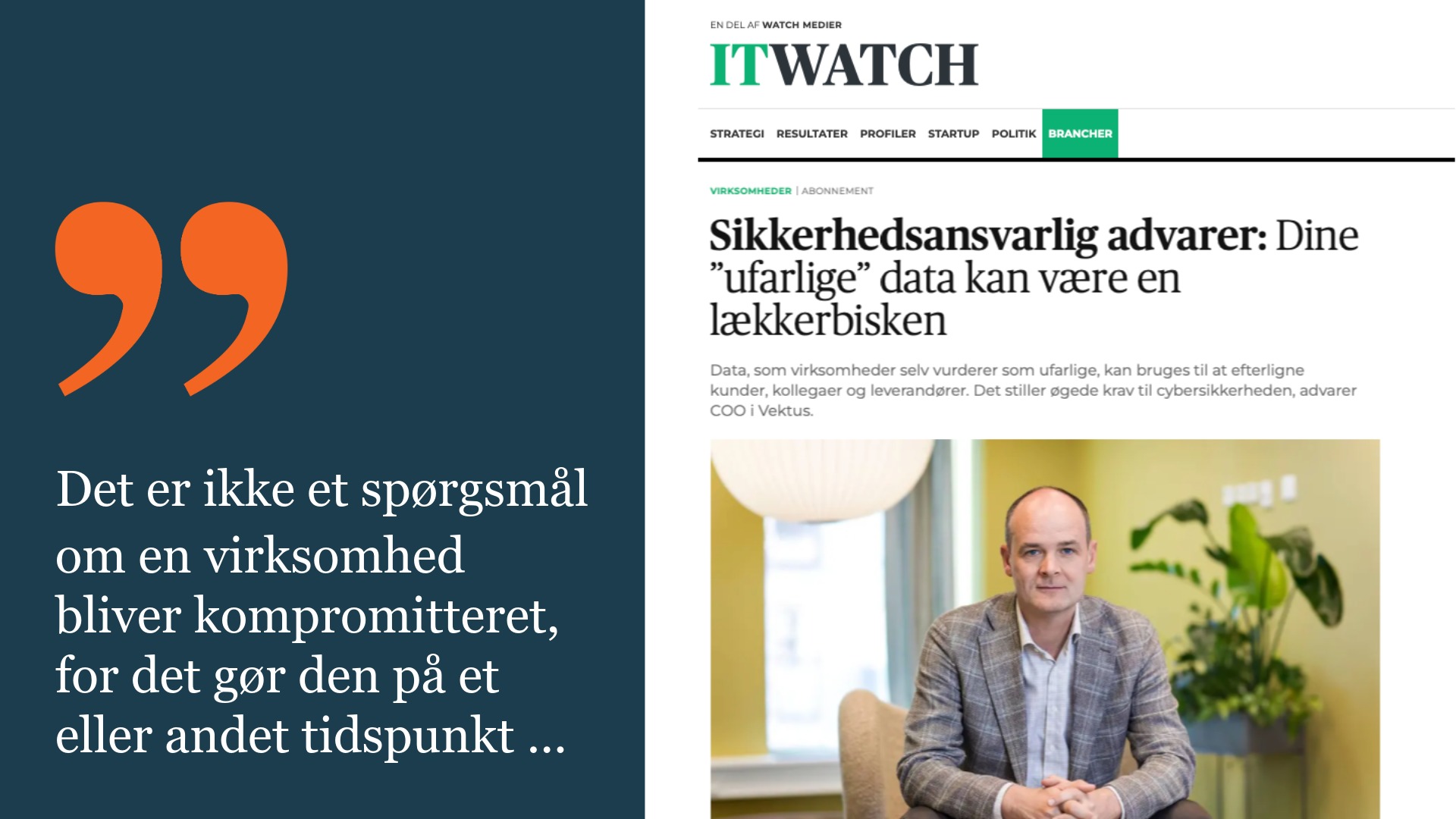
The threat landscape has changed. It is no longer just the data we traditionally consider sensitive that may be of interest to unauthorized parties. Ordinary data from email, ERP, and CRM systems can, when taken together, reveal a great deal about how a company operates, who it does business with, and how employees, customers, and suppliers communicate. With AI, that knowledge can be synthesized and leveraged in new ways. This is one of the key points made by our COO, partner, and Chief Security Officer, Jakob Wrang, in Susanne Horsdal’s latest article on cybersecurity in ITWatch.
Security must be built in from the start
When we work on solutions for our customers, access and permissions are therefore an important part of the process.
Who should have access to what? What information does each employee actually need? And which systems need to be able to communicate with one another?
The point isn’t to make everyday life difficult. It’s about not granting more access than is necessary. If an account or system is compromised, restricted access rights can help limit how far an unauthorized user can go. At the same time, it also protects individual employees, because a single mistake doesn’t necessarily grant access to everything.
At Vektus, we apply the same principle internally. In the article, Jakob Wrang explains, for example, that employees can only access Vektus’ systems from their own physical computers and from Western Europe.
The solution must be backed by muscle
Safety isn’t just about preventing things from going wrong. You also have to be prepared for what to do when something does go wrong.
Here, Jakob Wrang highlights one of the benefits of entrusting business-critical systems to major players like Microsoft. A large platform has the resources and capacity to continuously work on prevention, respond to new threats, and assist with recovery if an attack occurs.
It can be difficult to maintain the same level of capacity on one’s own, for example, if a serious incident occurs at night, during a holiday period, or at a time when the company’s own IT resources are limited.
It is that sense of security and capacity that that Jakob Wrang highlights as an argument for choosing solutions on large platforms, which are backed by comprehensive security measures, rather than having to handle the entire security burden on one’s own—or relying on smaller players with limited capacity.
Technology alone is not enough
Even with robust technical security measures, people remain an integral part of security.
Fraud is becoming more sophisticated, and AI can make it harder to spot fraudulent inquiries. Therefore, the solution isn’t simply to tell employees not to click on the wrong link. The company must also configure its systems, access controls, and processes so that human error does not lead to unnecessarily severe consequences.
It’s about protecting both the company and the employee. As Jakob Wrang points out, a wrong click is rarely the result of malicious intent. The employee has usually just been trying to do their job in a situation where fraud has become increasingly difficult to detect.
The basics are still some of the most important things
AI is changing the threat landscape, but much of good cybersecurity is still about the basics:
- Who has access to what?
- Do employees have only the permissions they need?
- Which systems can communicate with each other?
- Are the systems updated regularly?
- Is backup managed properly, and is the backup environment itself protected?
- Is there a plan to restore systems and data if something goes wrong?
- And is there someone with the necessary capacity to respond when an incident actually occurs?
That is also why security is such a key part of our work at Vektus. Not as something that is added to the solution after the fact, but as something that must be built into the way the solution, access, and permissions are set up.
You can read the full article on ITWatch here (the article is behind a paywall):


